
Align Your Body Before Pain, Fatigue, and Performance Issues Appear
Posture isn’t just how you stand.
It’s how your body organizes itself in every movement, every rep, and every step you take.
At the surface, you notice discomfort, stiffness, or reduced performance.
Beneath that are muscular imbalances, joint stress, and inefficient movement patterns.
At the foundation is your postural alignment—how your body stacks itself against gravity.
When that foundation is off, the effects travel upward. Energy leaks into unnecessary tension. Recovery slows. Performance feels harder than it should. And over time, small alignment issues can become chronic pain or recurring injury.
Technology-based postural assessment helps uncover these problems early—before they show up as limitations.
What to Expect from the Technology-Based Postural Assessment at Physora Physio
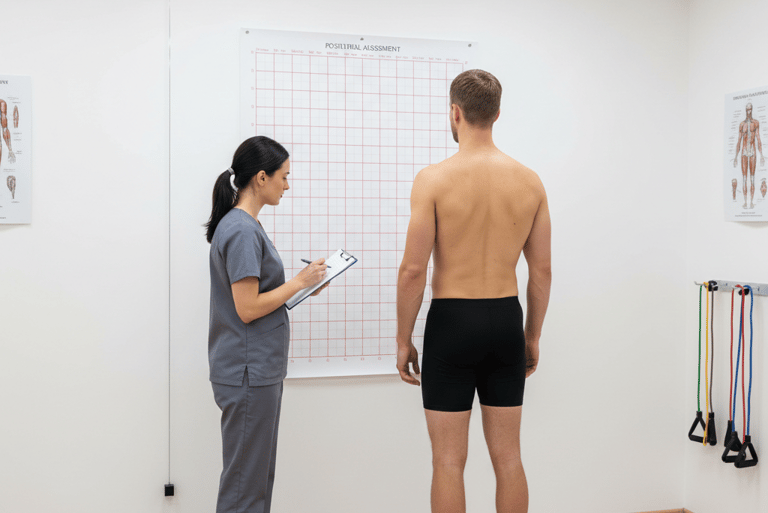
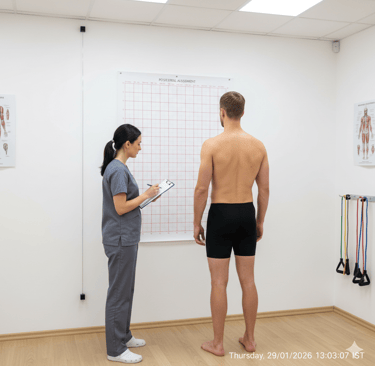
Our digital postural assessment combines advanced imaging and movement analysis software with clinical expertise to create a precise, full-body map of your alignment, balance, and symmetry—both at rest and in motion.
This system is used in professional sports, rehabilitation settings, and high-performance training environments to deliver objective, measurable insights rather than guesswork.
The goal is simple: see what the naked eye can’t—and correct it before it becomes a problem.
Precision Posture Mapping
We analyze your body’s alignment from head to toe, identifying shifts, rotations, and asymmetries across key regions such as the spine, shoulders, hips, knees, and ankles.
These subtle deviations often develop from daily habits, previous injuries, long hours of sitting, or repetitive training patterns. Left unaddressed, they can alter load distribution across joints and muscles, increasing strain and reducing efficiency in movement.
Data-Driven Performance Insights
Beyond static posture, we assess how your body holds and controls alignment during functional positions and movement transitions.
This allows us to identify where stability breaks down, where muscles overcompensate, and how force travels through your body under load. The result is a clear roadmap for targeted correction—improving comfort, efficiency, and performance while reducing the risk of injury.
Get in touch


Powered by Physora Physio
Copyright © 2025 Physora Physio